
Introduction
History
Concurrent with the establishment of the Faculty of Engineering at the University of Kurdistan in 1995, the Department of Electrical Engineering commenced its activities by admitting 30 students in the Associate degree program in Electronics. The department began its undergraduate program in Electrical Engineering with a focus on Electronics in 2002, followed by the Power engineering focus in 2008. At the Master's level, specializations in Power, Control, Electronics, and Communications were added in 2007, 2011, 2012, and 2013, respectively. The PhD program in Power engineering was added in 2012. In 2020, the Department of Electrical Engineering was divided into two separate departments: the Department of Power and Control Engineering, and the Department of Electronics and Communications Engineering. Approval for establishing a PhD program in Electronics was obtained in 2021, with admissions commencing in 2022.
Electronics Focus
Electronics is one of the main branches of electrical engineering, whose primary objective is the fabrication of semiconductor components and devices, and subsequently their use for designing and implementing processing and control systems. The role of chips and electronic systems is crucial in the simplest devices (such as toys and household appliances) to the most complex and massive systems (such as spacecraft, navigation systems, and telecommunication facilities). Given the vast scope of electronics science, numerous sub-disciplines are defined for it, among the most important of which are the following: Communication receivers, digital electronic system design (designing microelectronic chips for processing audio, video signals and constructing suitable hardware), micro-nano electronic device fabrication (simulation and fabrication of components such as transistors, solar cells, absorbers, and electronic sensors), analog electronic system design (designing integrated circuits for analog signal amplification for use in transmitter systems – to execute user commands such as computer processors).
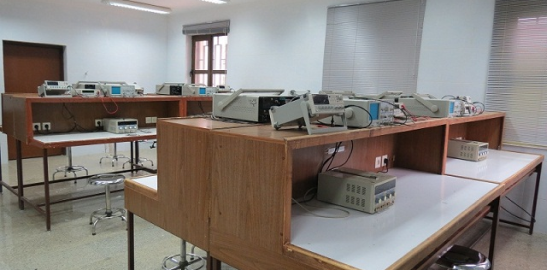
The University of Kurdistan operates in the undergraduate Electronics focus, the Master's focus in Micro-Nano Electronic Devices, and the Master's focus in Integrated Circuit Design. The goal of offering this program is to train specialists in the field of understanding the operation, maintenance, utilization, analysis, and design of electronic systems in various industrial and service units across the country. For this purpose, in this program, students in related educational laboratories become familiar with the principles of designing electronic boards as well as using existing industrial boards to implement widely used electronic systems in our country's industry. The undergraduate courses in the Electronics focus, in addition to familiarizing students with the principles of the electronics branch, are planned in such a way as to suitably prepare students for continuing their studies at higher levels.
Communications Focus
Considering the increasing role of communication and information transfer in human life and the diversity of telecommunication industries within the country, training specialized experts in the fields of understanding the operation, maintenance, utilization, analysis, and design of communication systems is of great importance. In the undergraduate Communications program, under titles such as Communication Systems, Signal and Image Processing, Antennas, Fields and Waves, Light and Electromagnetic Wave Propagation, Transmission Lines, Microwave, Multimedia Systems, Optical Communications, Photonics, Computer Communication Networks, Radar and Satellite Communications, students study issues and techniques of information transmission in radio systems, cables, and space. Furthermore, students are trained and conduct research on various components, circuits, and systems used in communications. This field, due to its close connection with electronics, has played a significant role in the evolution of electronic devices and components, to the extent that circuits on a communication scale can be seen as the result of efforts in designing advanced electronic circuits. Currently, in the Communications group, educational and research activities are conducted in the following areas:
• Photonics
• Optical Communication Networks and Multiple Access Systems
• Wireless and Mobile Communication Systems
• Microwave and Millimeter-Wave Communication Circuits and Systems
• Digital Signal Processing (Audio and Video)
• Cryptography and Communication Network Security
• Data Communication Networks and Broadband Communications
• Radar and Electronic Surveillance Systems
• Radio Wave Propagation and Computational Electromagnetics
Students of Electrical Engineering in the undergraduate program, after completing basic courses (mathematics, physics, statistics, etc.) and core courses (principles of communication systems, electromagnetics, etc.), must complete specialized communications courses including Filter and Synthesis, Fields and Waves, Antennas, Microwave, Digital Communications, Digital Signal Processing, etc., to graduate with a degree in Electrical Engineering with a Communications focus. This field at the Master's level is divided into two main specializations: Field and Systems, Networks and Cryptography. The Systems specialization examines topics such as communication networks, signal processing (audio and video), design of modulation and coding techniques, as well as detectors. In the Field specialization, topics such as wave propagation in different media, photonics and design of optical structures, design of antennas and microwave circuits and radars, as well as issues related to electromagnetic protection or hazards are discussed.